
The 1947 Wheat Penny featuring the "D" mint mark represents an object of detailed numismatic analysis.
The "D" mark indicates the coin's production in Denver, Colorado.
This facility in 1947 released a significant volume of monetary units, totaling 194,750,000 specimens.
Despite the mass production nature, the presence of this letter, combined with specific technical characteristics, can multiply the lot's value at auctions.
Provided below are confirmed data regarding pricing and rarity factors of the Denver issue.
Matching the 1947 D penny value against indicators from other production sites of the same period is necessary for proper understanding.
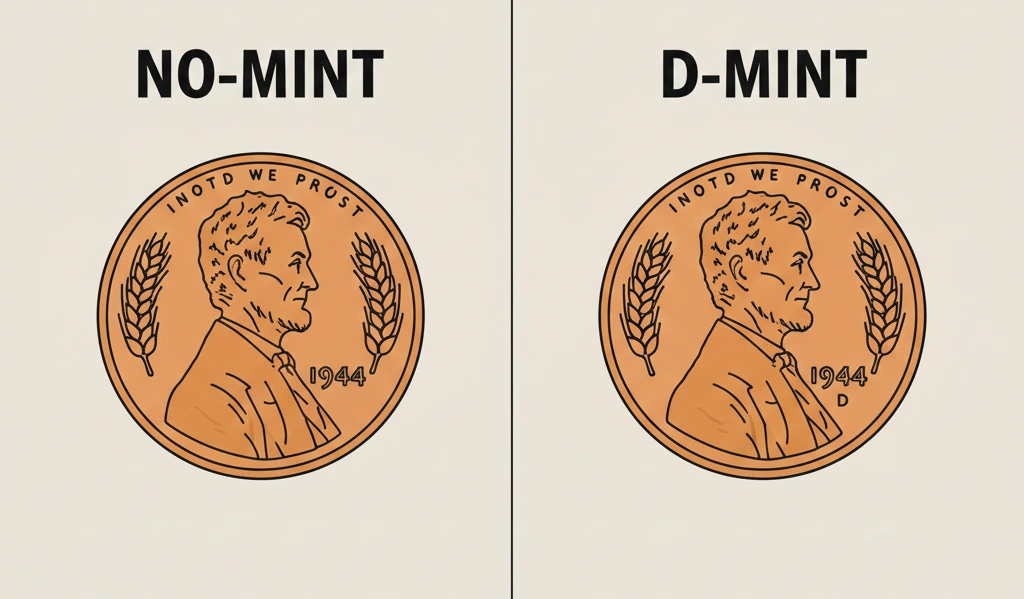
The total 1947 mintage was distributed among three cities unevenly.
Mint Facility | Designation | Quantity (Millions) | Share of Total Mintage |
Philadelphia | None | 190.4 | 39.3% |
Denver | D | 194.7 | 40.2% |
San Francisco | S | 99.0 | 20.5% |
The Denver Mint provided the largest contribution to the money supply of this denomination in 1947.
This fact results in high survival rates for coins in low and medium grades, minimizing their market premium.
Superiority of the Denver Strike
Numismatic studies record higher quality of die execution in Denver compared to Philadelphia.
Using high-quality steel tools allowed for maintaining detail clarity throughout long work cycles.
The sharpness of lines in the "IN GOD WE TRUST" inscription and detailed rendering of Lincoln’s beard are characteristic features of Denver specimens.
This circumstance leads to the frequent assignment of high Sheldon scale scores to 1947-D coins.
Meanwhile, an oversupply in grades MS63–MS65 keeps prices at the level of 3–15 USD.
A price explosion is observed exclusively upon reaching the MS67 threshold.
Price Anomalies and 1947-D Auction Records
The market for 1947 Denver coins is characterized by a sharp value jump when transitioning to the highest preservation states.
Below is the price change statistics depending on the grade for the Red (RD) category.
MS66 RD: The average price is 40–50 USD, demonstrating stability over 5 years.
MS67 RD: The price varies from 180 to 280 USD, showing a growth trend of 4% annually.
MS67+ RD: The value reaches 600–900 USD.
MS68 RD: The current quality limit for this issue.
The auction record for the 1947-D was established in 2013 at Heritage Auctions.
A coin in MS68 RD condition was realized for 1,410 USD.
In 2018, an identical specimen showed a price of 1,290 USD, confirming a slight market correction (about 8%) in the super-elite grade segment.
Impact of Repunched Mint Mark (RPM) on Value
A primary factor for price doubling and more significant growth is the technical error known as the Repunched Mint Mark (RPM).
In 1947, several dies with a manual "D" letter punching defect were used in Denver.
The punching process required two hammer strikes, with any offset creating a visible shadow under the main letter.
RPM varieties are classified in CONECA manuals as RPM-001, RPM-002, and so on.
RPM-001 (D over D North): The second "D" letter is visible above the main one.
RPM-002 (D over D South): The letter shadow is shifted downward.
A coin featuring the D mark and possessing a clearly defined RPM in MS65 RD condition is valued at 75–125 USD.
This exceeds the value of a standard 1947-D coin in the same grade by 6–8 times.
Discovering a rare type of die offset allows for realizing the coin at a price exceeding its face value by thousands of times.
Price Change Factors in Percentage Terms
Wheat cent value dynamics follow strict market laws.
Investors analyze annual population reports compiled by grading companies.
Annual Increase for MS67 RD: +4.2% (10-year average).
Value Decrease upon Color Loss (RD to RB): -65%.
Value Decrease when Transitioning from RB to BN: -80%.
These figures confirm the necessity of preserving the original copper surface.
Metal oxidation caused by improper storage destroys the investment potential of the "D" mark over a few years.
The rarity of coins with the "D" mark is confirmed by coin appraisal app registry data.
Grade | 1947 (P) Quantity | 1947-D Quantity | 1947-D Scarcity (%) |
MS66 RD | 1,450 | 1,820 | -25% (More accessible) |
MS67 RD | 32 | 168 | +425% (More accessible) |
MS67+ RD | 1 | 14 | +1300% (More accessible) |
Statistics prove that the 1947-D coin in top quality occurs 5 times more often than the Philadelphia issue.
This explains why the Philadelphia record price ($4,320) is significantly higher than the Denver record ($1,410).
The "D" mark provides a lower entry threshold for collectors wanting to own an ideal specimen.
Minting Errors Unique to the Denver Mint
Besides standard RPMs, specific defects are recorded for 1947-D.
Clipped Planchet: Occurs during a feed strip failure in the blanking press.
A coin featuring a "D" and a 15% weight deficit is worth 40 to 70 USD.Die Clash: Occurs when dies strike each other without a planchet.
Contours of the reverse side (wheat ears) appear on the obverse.
Such a defect adds an additional value of 15–25 USD to the coin.
These technical nuances, complementing the "D" mark, form the final market price.

Investment Forecast for the 1947-D
Based on data from the last five years, experts predict the continuation of the current trend.
Mass grades (up to MS65) are not considered a means of capital appreciation.
Main activity is concentrated in the MS67 sector and higher.
The influx of new collectors oriented toward completing year sets with all mint marks ensures the liquidity of Denver coins.
The annual trading volume of 1947-D coins on major platforms (eBay, GreatCollections) grew by 12% in quantitative terms.
This indicates high asset turnover despite its commonness.
Conclusion
The "D" mark on the 1947 Wheat Penny is a determining factor during valuation in the top market segments.
On its own, it does not make the coin rare due to the enormous mintage.
However, combined with an MS67+ grade or an RPM variety, the coin's price increases hundreds of times compared to base values.
Studying auction archives with the coin value app allows for concluding the stability of the Denver issue as reliable numismatic material.
Detecting the "D" letter under the date requires immediate inspection for microscopic strike defects.
These details, being confirmed by professional expertise, turn an ordinary cent into a valuable historical artifact.
