
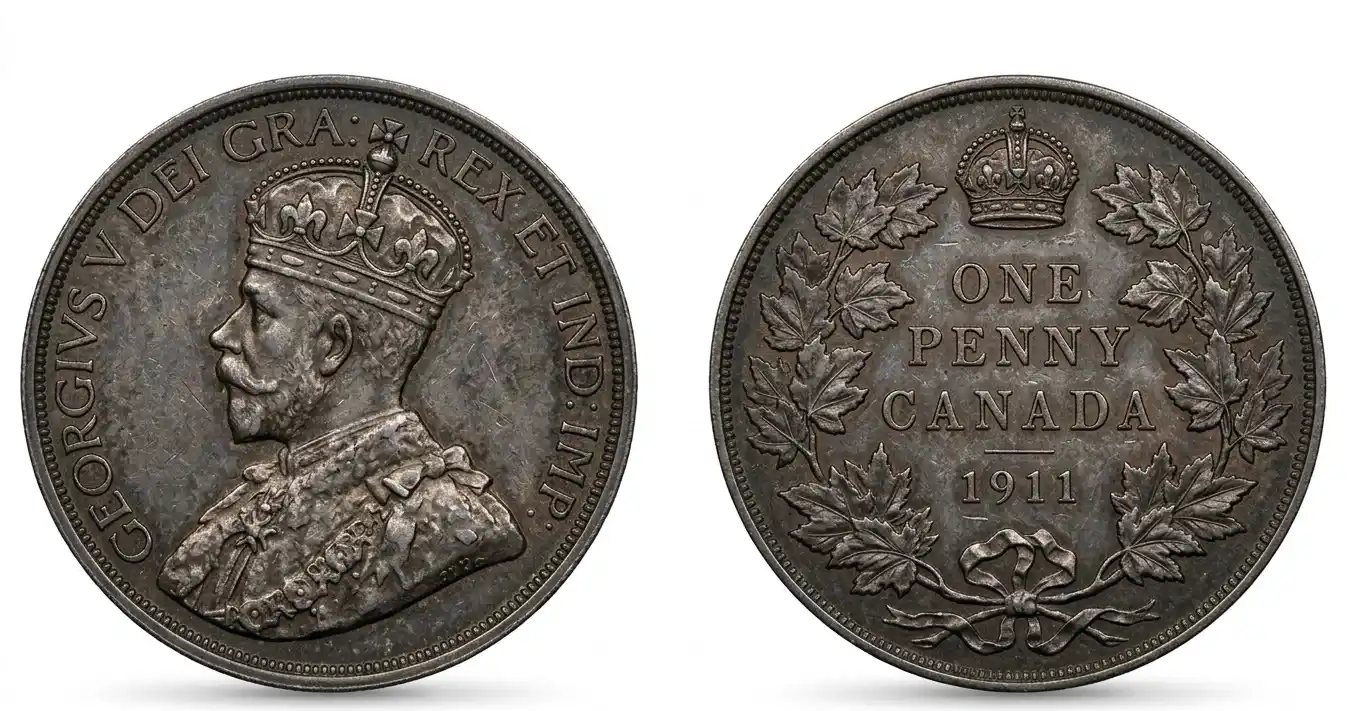
Every entry relies on market performance rather than subjective estimation.
Verified sales figures highlight these specific coins from the Top 100 Canadian Pennies Worth Money list.
Year of Issue | Variety Description | Sheldon Scale Grade | Record Price (USD) |
1936 | Dot Penny | SP-66 | $402,500 |
1953 | Shoulder Fold | MS-65 | $3,200 |
1858 | Large Cent | MS-65 Red | $21,000 |
1887 | Victoria Cent | MS-66 Red | $17,000 |
1921 | Small Cent | MS-66 Red | $2,700 |
Only three confirmed specimens of the 1936 Dot Penny exist.
Produced in 1937 using 1936 dies, this coin remains the pinnacle of Canadian rarity.
Large Cent Era: 1858–1901
Production of Large Cents occurred in London and Birmingham before moving to Canada.
Environmental wear on copper surfaces drives the premium for high-grade survivors.
Physical Standards:
Material: Bronze
Mass: 5.67 grams
Size: 25.4 mm
Priority Targets: Large Cents
1858 Issue.
Initial year of the denomination.
Mintage reached 421,000 pieces.
VF-20 grade value stays near $100.
MS-63 examples frequently exceed $5,000.
1859 Brass Strike.
Accidental production using yellow metal blanks.
Fewer than 20 units identified to date.
Market prices fluctuate between $15,000 and $25,000.
1891 Small Date/Small Leaves.
Rare die combination.
AU-50 valuation sits at $850.
Value Trajectory (Large Cents):
2015 Average → $40
2026 Average → $68
Total growth measured at 70%.
Small Cent Transition: 1902–1936
Transitioning from large to small formats in 1920 altered all manufacturing specs.
Economic shifts during this period resulted in several low-mintage "key dates."
Year | Identifying Mark | Mintage | MS-60 Price (USD) |
1907 H | Heaton Mint Mark | 800,000 | $150 |
1922 | Low Production | 1,243,635 | $120 |
1923 | Primary Key Date | 1,019,002 | $250 |
1924 | Semi-Key Date | 1,593,195 | $85 |
1925 | Scarce Issue | 1,000,652 | $220 |
Small Cent Dimensions:
Mass: 3.24 grams
Size: 19.05 mm
Reduced output in 1923 compared to 1922 → Supply drop of 18% → Market value increase of 108%.
King George VI Period: Errors & Varieties (1937–1952)
Implementing the maple leaf reverse design updated the penny's aesthetic in 1937.
Technical defects during minting created the most valuable sub-sets here — check them via a coin identifier.
Verified Error List:
1947 ML Blunt 7 — valued at $15 in XF.
1947 ML Pointed 7 — valued at $40 in XF.
1948 A off to denticles — valued at $100 in MS-60.
1949 A pointed to denticle — valued at $450 in MS-63.
Cause for 1948 Scarcity:
Delayed delivery of tools from India → Total mintage capped at 7,027,000 → Modern shortage in mint state.
Elizabeth II Era: Final Decades (1953–2012)
Official penny production ceased in Canada in 2012.
Modern values stem from portrait variations and metal changes.
1953 and 1955 Comparison
Two distinct obverse types appeared in 1953: with or without the shoulder fold.
Rarity exists in the No Shoulder Fold (NSF) variant when paired with specific die sets.
1955 Data:
1955 No Shoulder Fold (NSF).
MS-64 Red valuation → $1,100.
Annual price appreciation → 4.2%.
Selected Modern Variations (1965–1985)
Year | Error/Variety Type | Identification | MS-65 Price (USD) |
1965 | Large Beads | Large rim dots | $45 |
1965 | Pointed 5 | Sharp digit 5 | $30 |
1983 | Near Beads | Beads close to rim | $150 |
1985 | Pointed 5 | Unusual 5 shape | $180 |
Composition Specs (1997–2012):
Core: Steel
Exterior: Copper
Mass: 2.25 grams
The Master List: Top 100 by Rank
Market demand categorizes these 100 coins into four distinct tiers.
Tier 1: Investment Grade ($1,000+)
1936 Dot.
1859 Brass.
1858 Large Cent MS-64+.
1955 NSF MS-65.
1891 Small Date/Small Leaves MS-63.
1923 MS-65 Red.
1925 MS-65 Red.
1922 MS-65 Red.
1888 Victoria MS-66.
1876-H Large Cent Specimen.
Tier 2: Premium Collector Items ($100–$999)
1907-H (High Grade).
1923 (Mid Grade).
1925 (Mid Grade).
1949 A Pointed (Mint State).
1985 Pointed 5 (MS-64).
1983 Near Beads (MS-64).
1892 Obverse 2.
1900 Over 90.
1859 9 over 8.
1954 NSF (Mint State).
1953 SF (MS-64).
1924 (AU).
1922 (AU).
1884 (VF).
1882-H (XF).
1876-H (Fine).
1894 (VF-20).
1908 (MS-62).
1911 (MS-65).
1931 (MS-65 Red).
Tier 3: Notable Errors & Varieties ($10–$99)
1962 Hanging 2.
1964 Extra Water Line.
1965 Small Beads.
1967 Double Die Reverse.
1979 Double 979.
1982 Small 2.
1999 P (Plated).
2006 Magnetic (P).
2006 Non-Magnetic (No P).
2000 W (Winnipeg).
1947 ML Blunt 7.
1947 ML Pointed 7.
1951 High Relief.
1952 Double Date.
1940 Newfoundland (MS-60).
1942 Newfoundland (MS-60).
1913 (MS-63).
1915 (MS-63).
1917 (MS-63).
1918 (MS-63).
Tier 4: Accessible Scarce Dates (under $10)
51-100. Includes 1920, 1921, and 1926–1930 issues in Fine condition, plus 2012 final-year sets in Uncirculated state.
Average lot price for 50 coins in this category sits at $45 — see your coin’s price with the best coin identifier app free.
Metal Content and Preservation
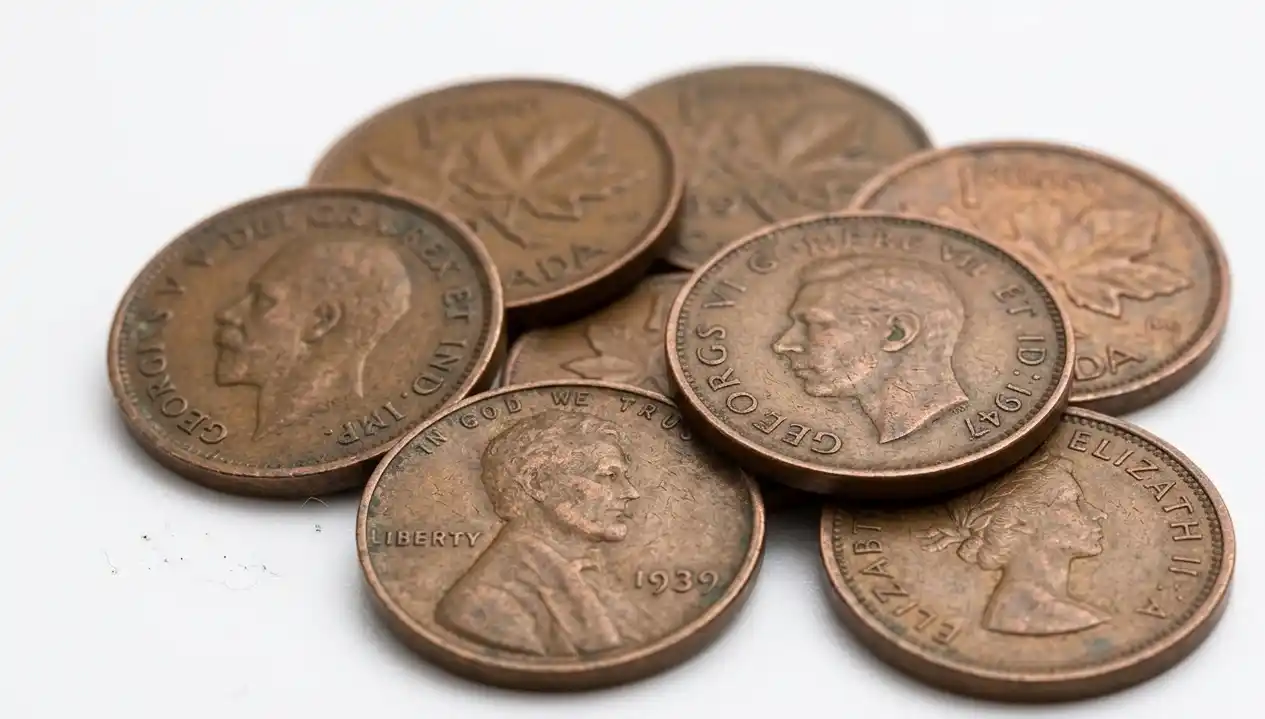
Longevity of Canadian pennies depends entirely on their metal mix.
1858–1920: Bronze (Copper, Tin, Zinc). High patination risk.
1920–1977: Bronze (High Copper content). Vulnerable to "copper rot" in moisture.
1978–1981: 98% Copper.
1982–1996: 98% Copper or Bronze mix.
1997–1999: Zinc with Copper coating.
2000–2012: Steel with Copper coating.
Rusting on steel coins → Value reduction of 90% regardless of initial grade.
Production Volume vs. Market Availability
Mintage totals over 104 years exceed 35 billion pieces.
Total weight reaches approximately 94 million kilograms.
Despite massive numbers, fewer than 0.01% remain in MS-65 or higher condition.
Withdrawal process since 2012:
Bank collection → Industrial melting → Significant reduction in surviving variety pools.
